

The Benazir Income Support Programme (BISP 8171) has remained one of the most important social welfare initiatives in Pakistan. Since its launch, it has provided direct cash assistance to millions of vulnerable families who otherwise struggle to meet their daily needs. Rising food prices, limited employment opportunities, and lack of access to education and healthcare have made this program a lifeline for countless households.
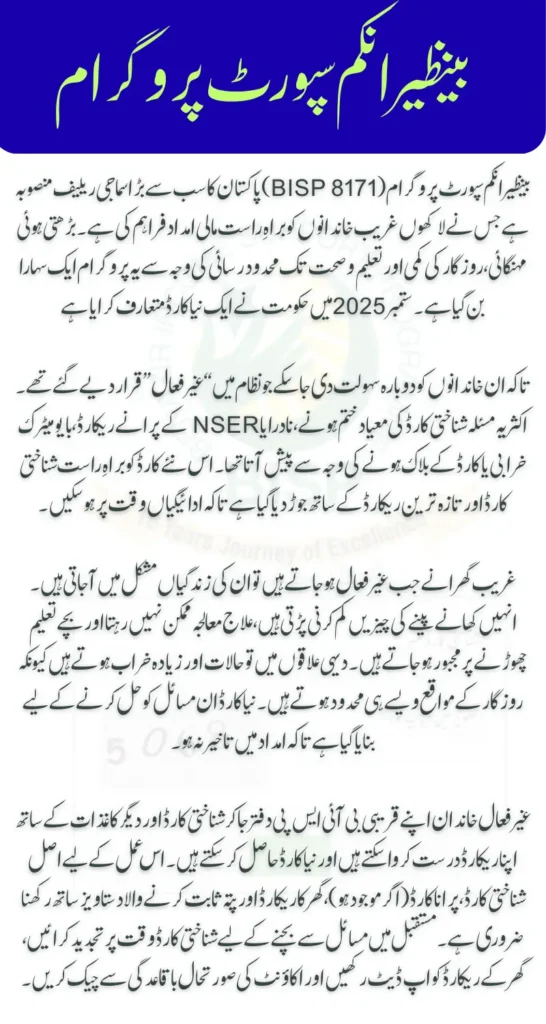
In September 2025, BISP introduced a fresh card designed to address a growing challenge faced by many beneficiaries. A large number of eligible families were being marked as “inactive” in the system, which meant that despite qualifying for the program, their payments were stopped. To solve this issue, the government has rolled out a new card system that ensures smoother payment delivery and restores financial security for affected families.
Why the New Card Was Launched
For years, beneficiaries have complained about sudden interruptions in their payments without any clear explanation. Many households that depended entirely on BISP cash transfers found themselves unable to access their funds. This problem was not due to disqualification but rather due to technical issues or outdated records.
You can also read: BISP 8171 Payment Deduction Complaint System September 2025
Some common issues included expired CNICs, mismatched biometric records, inactive or blocked cards, and outdated household information in the National Socio-Economic Registry (NSER). These errors caused families to be marked inactive. In response, the government introduced the fresh BISP 8171 card in September 2025 to replace problematic cards and re-establish a reliable payment system. The card directly links with updated CNIC and NSER data, ensuring that financial assistance reaches the right families without unnecessary delays.
Common Reasons Beneficiaries Become Inactive
Beneficiaries are often surprised to see their status as inactive. This does not mean they are permanently removed from the program, but it does pause their payments until corrections are made. The most common reasons include:
- Expired or unlinked CNICs that need renewal.
- Errors or outdated data in NSER records such as unreported births, deaths, or change in address.
- Biometric mismatches at payment centers due to fingerprints not matching.
- Expired, blocked, or damaged BISP cards.
- Temporary suspension during audit or verification reviews.
Each of these issues can be corrected, and the new card is specifically designed to minimize such problems in the future.
Impact of Inactive Status on Families
The consequences of being marked inactive are severe for poor households. Families dependent on regular cash transfers suddenly find themselves without any support. Parents are forced to cut back on essential items like food, while medical expenses become impossible to cover. Children may miss school due to unpaid fees or lack of transportation money.
You can also read: BISP Taleemi Wazaif 2025 Payment Schedule
In rural areas, where opportunities for employment are already limited, the impact is even worse. Families often have no alternative sources of income and are forced to borrow from relatives, neighbors, or even moneylenders. This not only creates financial stress but also traps them in long-term cycles of debt. Social pressure and mental stress further weaken already vulnerable communities.
Features of the Fresh BISP 8171 Card
The new card comes with several features that directly address the problems faced by inactive beneficiaries. Some of the most important benefits include:
- Direct linkage with CNIC and updated NSER records.
- Replacement for expired, blocked, or damaged cards.
- Access to payments through banks, Postbank, and partner outlets.
- Reduction in inactive status caused by technical or verification issues.
- Improved reliability for both urban and rural households.
This step ensures that families no longer need to worry about delays caused by outdated systems.
Steps to Reactivate Status and Collect the Fresh Card
If your account is showing as inactive, you can still reactivate it and collect the new card by following these steps:
- Visit the nearest BISP Tehsil Office with your original CNIC and other supporting documents.
- Update household details such as number of dependents, address, or employment information.
- Complete the biometric verification process at the designated payment center or partner bank.
- Collect your fresh BISP 8171 card in person. Keep the acknowledgment slip or SMS confirmation as proof.
- If any problems remain, call the 8171 helpline to register a complaint or seek further guidance.
This process is designed to be simple but ensures that only genuine and eligible families are reactivated.
You can also read: BISP 8171 Web Portal Reopen September 2025
Required Documents for Fresh Card Collection
When visiting the office, keeping the right documents in hand saves time and avoids multiple visits. Below is the checklist:
| Document | Purpose | Notes |
|---|---|---|
| CNIC (original + copy) | Identity verification | Must be valid and not expired |
| Old BISP card (if available) | Replacement process | Even damaged or blocked cards should be shown |
| NSER slip or record | Household verification | Obtain a copy if misplaced |
| Proof of residence | Confirms address | Utility bill, rent slip, or domicile |
| Mobile SIM registered on CNIC | Communication & SMS alerts | Keep active for updates |
Preventing Inactive Status in the Future
Many beneficiaries face repeated issues simply because their records are not kept up to date. By taking a few preventive measures, you can avoid interruptions in future payments:
- Renew your CNIC before expiry to keep records valid.
- Update household information in NSER after births, deaths, or change of address.
- Always keep receipts of past transactions for record purposes.
- Regularly check your account status by sending your CNIC number to 8171 via SMS.
- Report lost, blocked, or damaged cards without delay.
These small steps ensure that your account remains active and your payments continue smoothly. BISP 8171 Introduces Fresh Card for Eligible Beneficiaries
Conclusion
The introduction of the fresh BISP 8171 card in September 2025 is a major step toward resolving the inactive account problem faced by thousands of eligible families. By directly linking the card with updated CNIC and NSER data, the government has provided a reliable solution to ensure that stipends reach the right beneficiaries without interruption.
You can also read: BISP 8171 SMS Issues Resolve Why Payments Get Delayed
For poor and vulnerable households, uninterrupted assistance is not just financial help but a lifeline that secures food, healthcare, and education. By keeping records updated and responsibly managing the new card, families can look forward to consistent support in the months ahead. BISP 8171 Introduces Fresh Card for Eligible Beneficiaries