

The Government of Pakistan has officially launched the Benazir Income Support Programme (BISP) Phase 3 payments in September 2025. Each eligible household is entitled to receive Rs. 13,500, a lifeline for families struggling with high inflation and limited income sources. The program, which is one of the largest social safety nets in South Asia, aims to reduce poverty by offering direct cash support to deserving families.
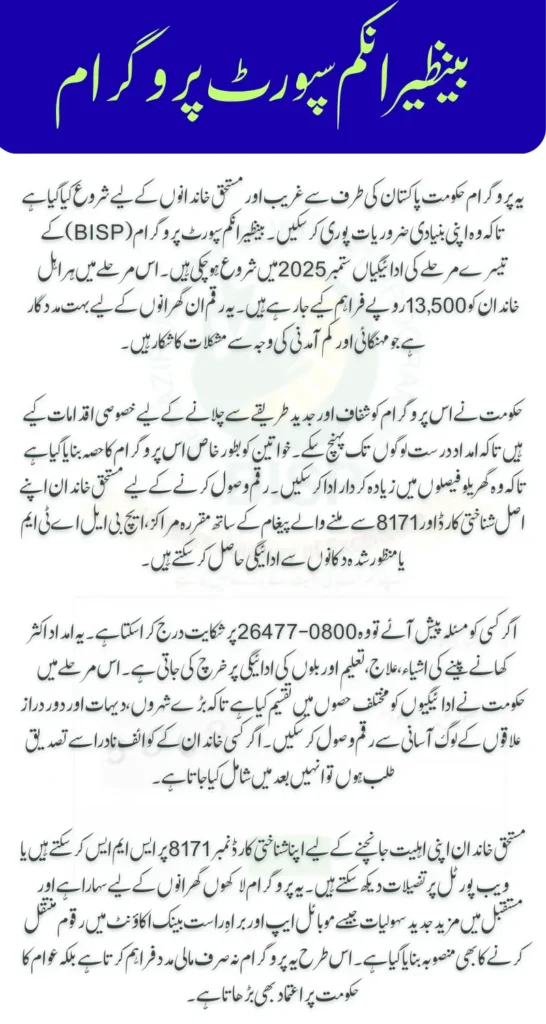
Phase 3 is more than just financial relief; it reflects the government’s commitment to a transparent and digital welfare system. By ensuring that payments reach the right beneficiaries without deductions or fraud, BISP continues to strengthen public trust. The program’s design particularly empowers women, as funds are transferred in their name, giving them a more active role in family decision-making.
Quick Facts Beneficiaries Should Know
Before exploring the details, here are the most important facts about BISP Phase 3 in September 2025:
- Payment amount: Rs. 13,500 per eligible family
- Start of rollout: First week of September 2025
- Eligibility check: CNIC to 8171 (SMS) or official web portal
- Collection channels: Ehsaas cash centers, HBL ATMs, and authorized shops
- Helpline number for complaints: 0800-26477
These quick points help families prepare in advance and avoid unnecessary delays when visiting collection points.
You can also read: BISP 8171 Payment Deduction Complaint System September 2025
Why BISP Phase 3 Payments Matter
The September 2025 installment under Phase 3 comes at a crucial time for Pakistan’s poorest households. Rising food prices, increased utility bills, and limited work opportunities have left many families struggling to survive. For them, this Rs. 13,500 installment is not just financial aid—it is the difference between sending children to school or keeping them at home, between being able to buy medicine or going without treatment.
By focusing on women as the main recipients, the program ensures that resources are used responsibly. Women are more likely to spend the money on essentials such as food, education, and healthcare. This approach not only improves the welfare of individual households but also contributes to better outcomes for entire communities.
Payment Schedule and Rollout Plan
Payments for Phase 3 began in the first week of September 2025 and will continue throughout the month. To make the process manageable and organized, the government has divided the rollout into stages.
- Major cities first: Large urban centers with high numbers of beneficiaries receive payments at the beginning of the rollout.
- Towns and rural areas next: Smaller towns and villages are included in the second phase of distribution.
- Pending and verification cases last: Families whose details require confirmation with NADRA or who faced technical issues receive their payments in the final stage.
This staggered system prevents overcrowding at cash centers and banks, ensuring that families receive their payments smoothly and on time.
Who is Eligible for Phase 3?
Eligibility remains one of the most important aspects of BISP Phase 3. Only genuinely deserving families are considered, and the government uses NADRA databases and earlier registration records to confirm status.
The main conditions are:
- Household income must be below the official poverty line
- No family member should be working in a government job
- Applicants should not own large properties or valuable assets
- Families must be registered in previous phases or verified through NADRA
Women who were already part of earlier installments continue to remain eligible without having to reapply. This ensures consistency and avoids unnecessary re-verification for long-term beneficiaries.
You can also read: BISP 8171 SMS Issues Resolve Why Payments Get Delayed
How to Check BISP Phase 3 Payment Status
Beneficiaries have two official ways to check whether they are eligible and whether their installment has been released. Both methods are simple and widely accessible.
Method 1: SMS Service
- Type your 13-digit CNIC number in a text message
- Send it to 8171
- Wait for the reply with eligibility and payment details
Method 2: Web Portal
- Visit the official BISP 8171 portal
- Enter your CNIC number and the security code shown
- Check eligibility, installment status, and collection location
It is recommended to keep a copy of the confirmation message or a screenshot of the web portal result before visiting the collection point. This reduces confusion and helps in case of disputes.
Payment Collection Points
The government has partnered with different institutions to make payments accessible nationwide. Families can collect their installments from multiple official channels, depending on their location.
Here is a clear overview:
| Region / Area | Payment Channel | What to Carry | Extra Notes |
|---|---|---|---|
| Nationwide | Ehsaas Cash Centers | Original CNIC + SMS | Biometric verification may apply |
| Urban Cities | HBL Partner ATMs | CNIC + Fingerprint | Faster withdrawals in major centers |
| Rural & Small Towns | Cash Shops / Points | CNIC + Confirmation SMS | Token system may be used |
By providing multiple options, the program reduces the travel burden on rural families and ensures that payments are accessible to everyone.
Required Documents – What to Bring
To ensure a smooth process at collection points, beneficiaries should bring the following documents:
- Original CNIC (mandatory for all recipients)
- Eligibility confirmation SMS from 8171 or web portal screenshot
- B-Form (if family verification is requested)
- Any token or slip provided during scheduling
Carrying the right documents avoids delays and ensures that payments are processed quickly.
You can also read: Sindh Free E-Bike Scheme 2025 For Worker Women Check Eligibility
Common Problems and How to Fix Them
Despite major improvements, some families may face issues while checking or collecting their payments. The most common problems include:
- Slow or busy portal: Try again at non-peak hours, especially in the morning or late evening.
- Incorrect CNIC entry: Double-check before sending SMS to avoid rejection.
- Pending verification: Visit NADRA to update your CNIC information and confirm records.
- Unlawful deductions by agents: Report immediately to the official helpline 0800-26477 and keep your receipt as proof.
These solutions ensure that beneficiaries can resolve their issues without unnecessary stress.
Fraud Prevention and Safety Measures
Fraud remains a concern, but beneficiaries can protect themselves by following a few simple precautions:
- Always remember that the official SMS number is 8171. No other number should be trusted.
- Do not share your CNIC or documents with unauthorized people.
- Collect payments only from official cash centers, ATMs, or authorized shops.
- Keep your payment receipt safe for future reference.
- Report suspicious activities directly to the BISP helpline.
By staying alert, families can ensure that their rightful assistance reaches them safely. BISP Phase 3 Payment Status Eligibility September 2025
You can also read: BISP 8171 September Double Payment 27000 Check Eligibility,
Impact of Rs. 13,500 on Families
For poor households, Rs. 13,500 is a meaningful amount that helps cover immediate needs. Families typically use it to purchase groceries, pay children’s school fees, cover healthcare costs, or pay electricity and gas bills.
The program also strengthens the role of women, who are more likely to prioritize essential needs when making spending decisions. In this way, the impact of the program extends beyond financial relief it promotes education, better nutrition, and healthcare access for children. BISP Phase 3 Payment Status Eligibility September 2025
Future Improvements in BISP
The government has announced plans to further modernize the system. Upcoming improvements include:
- A mobile application to allow real-time tracking of payments
- Faster processing of pending cases and reduced delays
- Direct transfer of funds into beneficiaries’ bank accounts
These measures will save time, reduce travel, and make the system even more reliable in the future.
Conclusion
The BISP Phase 3 payments of September 2025 are a vital support for millions of low-income families across Pakistan. By providing Rs. 13,500 per household, the program is helping people cope with inflation, cover essential expenses, and improve their quality of life.
To benefit from the program, families must:
- Check their eligibility through 8171 SMS or the web portal
- Carry their original CNIC and confirmation message when collecting payments
- Report any irregularities or deductions immediately to the helpline 0800-26477
You can also read: BISP 8171 Web Portal Payment Eligibility Check Online 2025
With each new phase, BISP is becoming more transparent, efficient, and supportive, ensuring that Pakistan’s most vulnerable citizens are not left behind. BISP Phase 3 Payment Status Eligibility September 2025